
Real clients, real numbers, pulled from live client reporting. Where a result is early or incomplete, we say so.
Client names are withheld for confidentiality. Every figure below comes from Google Search Console, Google Analytics, or Google Ads, and we will walk any prospective client through the source data.
Nationwide Legal Mediation Practice
6,395 pages of dead weight, removed in 17 days
- Multi-location
- 31 US markets
- Mid-size firm
- Client since 2026
The situation
A mediation firm operating across dozens of US markets, running significant Google Ads spend, with a website quietly working against itself.
Automated content generation had produced roughly 7,000 blog URLs. Most were duplicates or near-duplicates competing with each other for the same terms. Google had crawled the site and declined to index the overwhelming majority of it.
Meanwhile, paid campaigns pointed at landing pages that had never been optimized to convert. The single most-clicked page in the entire account converted nobody.
What we did
We deleted most of the website.
6,338 duplicate and cannibalizing pages plus 57 exact duplicates, removed over 17 days. The site went from roughly 7,000 blog URLs to 649 clean, intentional pages. A 91% reduction.
Then we rebuilt what was left: bulk meta descriptions across all 649 posts, tables of contents, index validation resubmitted to Search Console, and a market-by-market audit scoring every location on NAP consistency, schema, and page uniqueness.
On the paid side we rebuilt roughly 48 ad groups across 12 campaigns. Corrected demographic targeting that had been set to the wrong age bracket entirely. Disabled Display Network and Search Partners, which were spending budget on parked domains and low-quality inventory. Paused the highest-clicked, lowest-converting landing page and moved that budget to pages that actually converted. Lifted calls to action above the fold and embedded booking calendars directly on landing pages instead of hiding them two clicks deep.
The results
Cost per lead on campaigns we built: $65 to $99.
Cost per lead on campaigns we did not: $143 to $505.
Same client. Same markets. Same time period. The only variable is who built the campaign.
| Market | Our campaign | Prior campaign | Difference |
|---|---|---|---|
| Market A | $64.59 | $271 | 4.2× cheaper |
| Market B | $87.47 | $505 | 5.8× cheaper |
| Market C | $86.82 | $204 | 2.4× cheaper |
Average search position improved from 22.2 to 14.8 across the first quarter of the engagement, a 33% gain, alongside the best single month of organic clicks on record.
The takeaway
Most agencies would have pitched more content. This site’s actual problem was that it already had far too much and none of it was earning its place. Diagnosing that correctly was worth more than a year of publishing.
Multi-City Autism Testing & Therapy Centers
Rebuilt from the ground up, live in four months
- Multi-location
- 2 clinics + in-home
- Colorado
- Client since 2026
The situation
A behavioral therapy provider with two clinics plus in-home services, competing against national chains with 18+ locations in the same state and hundreds of Google reviews each.
The practice had never had a blog. Its contact form collected spam instead of appointments. Its Google Business Profile was unverified. Its sitemap had never been successfully indexed, meaning Google had no reliable map of the site at all.
And its business information was scattered: 3 different name variants, up to 7 different addresses across the web, and 5 phone numbers of which 2 were wrong, including one with an out-of-state area code. Two directories still listed a clinic that had closed. A state agency’s own provider referral list carried a wrong address.
For a family searching for care, every one of those is a dead end.
What we did in 120 days
A full brand transformation and a site migration, rebuilt around how families actually search for care rather than how the practice described itself internally.
Replaced the spam-choked contact form with live online booking, so an interested parent can schedule at 11pm instead of waiting for a callback.
Built the blog from zero: 22 articles, roughly 20,000 words, every one fact-checked against clinical sources.
Got both sitemaps successfully indexed in Search Console, which had been the single blocking issue. Built complete LocalBusiness schema for both clinics and the parent organization. Verified the Google Business Profile. Audited 25 directory listings, corrected the conflicting addresses and phone numbers, and began fixing the state referral record.
Where it stands
In April, AI had no idea this practice existed. By August, Google’s AI Overview names them directly, with phone number, for booking queries in their market, listed beside a national chain operating in multiple states. Ten terms have also reached page one of traditional search.
A practice Google could not reliably crawl in April is the answer Google gives families in August.
The takeaway
Four months is not long enough to win a competitive market, and we would not claim otherwise. It is long enough to rebuild the foundation completely, get indexed, get booked, and start appearing. That is what the first phase is supposed to do, and it is why the twelve month arc is worth committing to.
Mid-Size Multi-Therapist Mental Health Practice
From invisible to 474 ranking keywords
- Multi-therapist
- 1 location
- Denver metro
- Client since 2025
The situation
A multi-therapist practice with real content ambition and no technical foundation underneath it. No structured data of any kind. Inconsistent business information scattered across the web. A growing blog with no internal linking strategy, which meant individual articles had no way to pass authority to the service pages that actually convert.
What we did
We treated the content and the technical work as one project rather than two.
Built and deployed five validated JSON-LD schema blocks covering the practice, every therapist, and nine service pages, on a website platform that shipped with none.
Ran a full internal linking rebuild: 46 pages audited, 24 optimized, roughly 40 new links hand-placed and verified live, connecting every published article to the service page it supported.
Built 47 live citations and profile listings to establish consistent business information across the directory ecosystem. Published eight feature articles. Held a steady blog cadence on the specific concerns the practice specializes in.
The results
A blog with no schema, no internal linking and inconsistent citations is a library with no catalog. We built the catalog, and the writing that was already there started working.
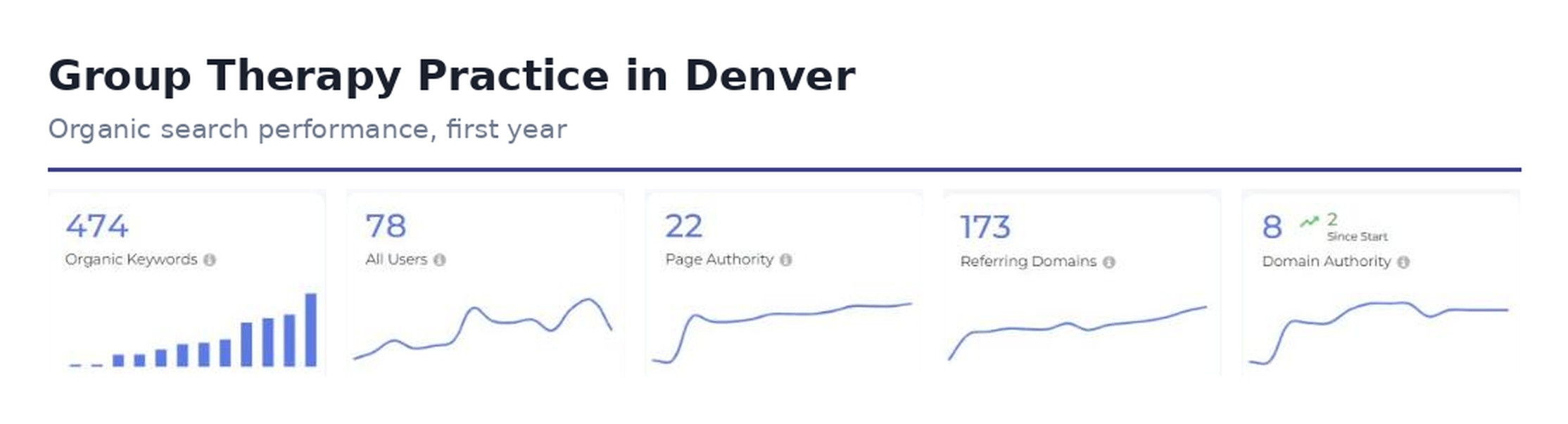
Live reporting dashboard. Client identifiers removed.
The takeaway
Content without technical infrastructure ranks for nothing. A blog on a platform with no schema, no internal linking, and inconsistent citations is a library with no catalog. We built the catalog, and the content that was already there started working.
Independent Dental Practice, Mountain Community
51 of 63 keywords in the top three
- 1 location
- Small mountain market
- Independent practice
- Client since 2024
The situation
A dental practice serving a small mountain community, competing for a limited local patient population against practices in larger neighboring towns with bigger marketing budgets.
In a market this size the objective is not traffic volume. It is owning the results for every service the practice offers, so that anyone within driving distance who searches for dental care finds this practice first, every time.
What we did
Local search fundamentals, executed completely rather than partially. Google Business Profile optimization, NAP consistency across the citation ecosystem, service page architecture mapped to how patients actually search, structured data, and steady authority building to 190 referring domains.
The results
Sixty-two of sixty-three tracked keywords sit on page one. Exactly one does not.
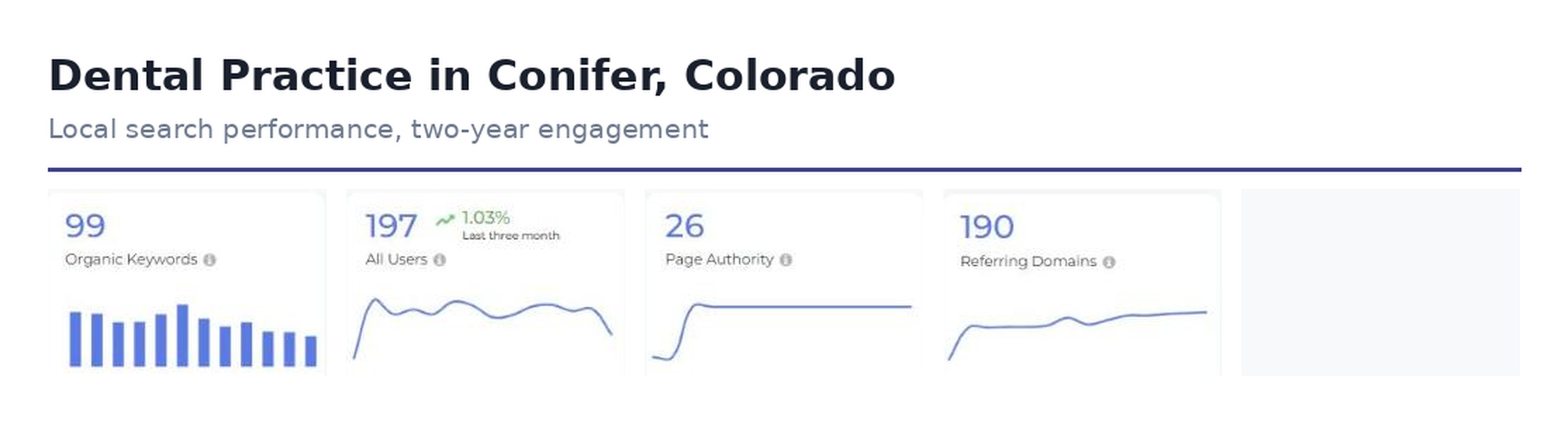
Live reporting dashboard. Client identifiers removed.
The takeaway
For a practice serving a defined geographic area, dominating a small keyword set completely beats ranking moderately across a large one. We track 63 keywords for this client because 63 is how many matter. Ranking first for all of them is the entire job.
Private Pay Perinatal Therapy Practice
The practice that owns a search category
- Category-dominating private pay practice
- Denver metro
- Client since 2023
The situation
A one-therapist perinatal mental health practice, in a metro area saturated with therapists. No meaningful search presence, no content library, and competing against national directory platforms that outrank individual practices by default for every obvious keyword.
What we did
We stopped competing for the obvious keywords.
Instead of fighting for “therapist near me,” we built a content library around the language people actually use when they are struggling at 2am and have not yet decided to look for a therapist. Informal, emotional, specific phrases that no competitor was targeting, because no competitor had listened closely enough to hear them.
Then we built the technical foundation and authority to make that content rank: 225 referring domains, structured data, internal linking, and three consecutive years of consistent publishing.
The results
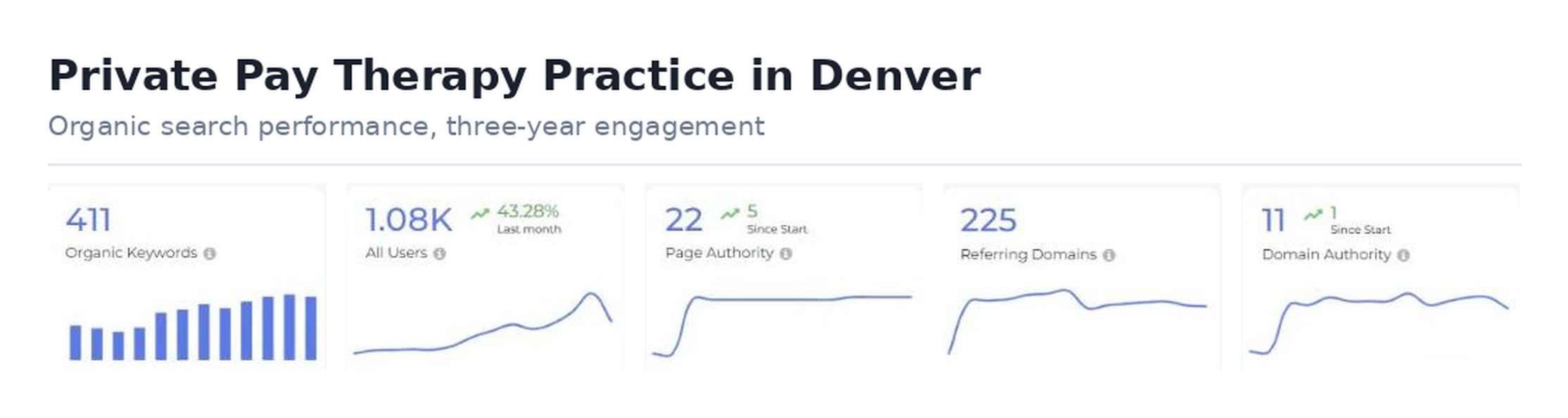
Live reporting dashboard. Client identifiers removed.
Here is the number that matters most: the practice name accounts for 18 of those 3,460 clicks.
Virtually every visitor had never heard of this practice. They searched a feeling, found an article that named it precisely, and arrived at a therapist who clearly understood them before they ever made contact.
The wins concentrate, too. A single article accounts for 1,138 clicks and 57,102 impressions on its own.
The takeaway
Authority compounds. Year one built the foundation, year two built the library, and year three is when the library started returning traffic the practice no longer pays for. That is the arc, and it is why we ask for twelve months.
Regional High-End Interior Designer
Page eight to the front page, in Maps, search and AI answers
- 1 studio
- High-end residential interior design
- Principal-led practice
- Client 2024–2025
The situation
A high-end residential interior designer with a genuinely beautiful website and no search presence whatsoever. For the two years before we started, the site ranked for roughly fifteen to twenty-five keywords, every single one of them at position 21 or lower. Page eight, nine, ten, or not showing up at all.
Zero keywords in the top three. Zero presence in Maps. Zero SERP features. Anyone who already knew her name could find her. Nobody else could.
This is the specific way design and creative businesses fail at search. The work is visual, the portfolio is the selling tool, and the site gets built to be looked at rather than to be found. The content is excellent and completely invisible.
What we did
Technical foundation first, because it had never been laid. The sitemap had never been successfully indexed, so Google had no reliable map of the site at all. We fixed the indexing, wrote alt text across the portfolio images, which on a design site is most of the page, and wrote real meta titles and descriptions rather than leaving Google to invent them.
Then authority. High domain-authority citations, a sustained backlink program, and editorial placement in design magazines. For an interior designer, press does two jobs at once: it is a link and it is a credential, and the credential is the part that closes clients.
Then content. A blog built from nothing, written around how people actually search for a designer rather than how designers describe their own work.
And a Google Ads campaign running alongside all of it, carrying enquiries through the months where organic had not caught up yet. That is the whole point of running the two together.
The results
She was on page eight. Not for lack of talent, for lack of a foundation. A beautiful site is not the same thing as a findable one.
The takeaway
Creative businesses tend to have the best content and the worst-optimized sites, and the fix is not a redesign. It is indexing, alt text, meta descriptions, citations, editorial placement and a content library. Unglamorous work that leaves the design completely untouched.
Keyword coverage peaked in early 2026, after the engagement had already ended, and the front-page positions have held in the twelve months since. It has eased off gradually without anyone maintaining it, which is exactly what should happen. Foundations keep working. They just do not keep improving on their own.
Find out where you actually stand
Tell me what is going on and you will leave knowing the right next step. Twenty minutes with me, free. Rather have me inside your accounts? Under the Hood is $500 one-time, with the first fixes made live.
Talk with KimberlyFree · 20 minutes. About Under the Hood